
WEIGHT LOSS TREATMENT
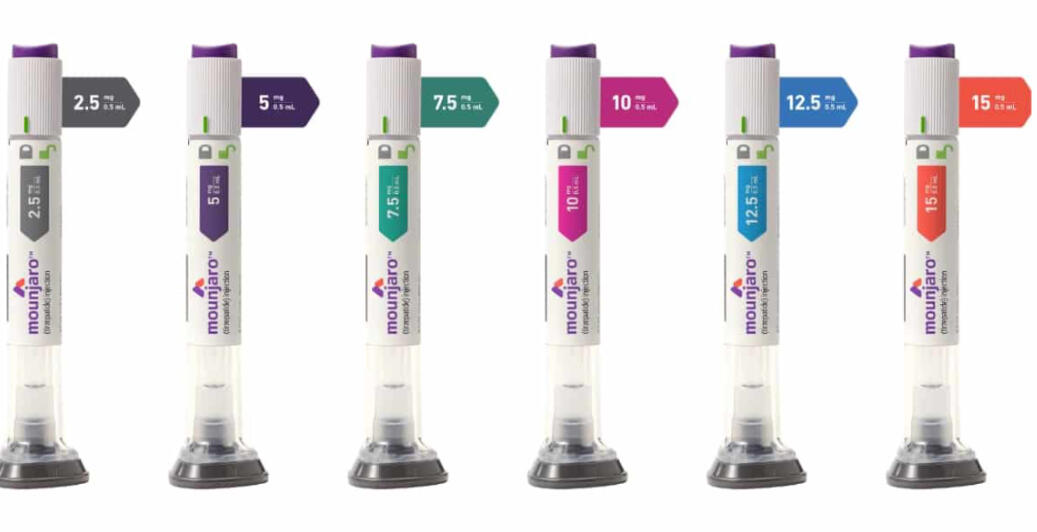
Mounjaro weight loss injections
A once-weekly injection pen containing tirzepatide, which works on two appetite hormones (GIP and GLP-1) to help you eat less and lose weight — prescribed only after a prescriber-reviewed consultation.
About Mounjaro
Mounjaro (tirzepatide) comes as a pre-filled KwikPen containing four fixed weekly doses. In the UK it is licensed for weight management in adults living with obesity, and for some adults who are overweight with a weight-related health condition. It works best alongside a reduced-calorie diet, regular activity, and ongoing clinical support.
Summary
| Active ingredient | Tirzepatide |
| Format | Once-weekly injection (pre-filled KwikPen, four weekly doses per pen) |
| Manufacturer | Eli Lilly |
| Strengths | 2.5 mg, 5 mg, 7.5 mg, 10 mg, 12.5 mg, 15 mg |
| Price | From £142.00 per pen (varies by strength — see price table below) |
| Prescriber review | Every consultation is checked by our prescriber before any supply is approved, and your dose is only increased when appropriate |
| Before you start | Read the Patient Information Leaflet supplied with your medicine |
What is Mounjaro?
Mounjaro is a dual-action weekly weight loss injection. Its active ingredient, tirzepatide, works through two hormone pathways at once — GIP and GLP-1 — where most other weight loss injections work on only one. In large clinical trials, people using tirzepatide alongside lifestyle changes lost a substantially higher proportion of body weight than with lifestyle changes alone.
How it works
After eating, your gut releases hormones that tell the brain you are full. Tirzepatide mimics two of them. In practice most people notice: a smaller appetite and fewer cravings between meals; feeling satisfied sooner and for longer, even with smaller portions; and steadier hunger through the day. It is not a stimulant and does not burn fat directly — it makes consistently eating less achievable, which is what drives the weight loss.
How long does it take to work?
It starts acting from the first dose — most people notice reduced appetite within the first week. Changes on the scales build over the following months, with visible results typically becoming clear from around month three. Progress isn’t only the number on the scales: how clothes fit and how you feel matter just as much, and your prescriber monitors your response before any dose change.
How to get Mounjaro
Our prescriber-led process, from first question to your door:
Complete the consultation
Answer a short medical questionnaire about your health, weight history, and goals.
Prescriber review
Our prescriber checks every answer to confirm the treatment is safe and suitable for you.
Discreet delivery
Dispensed by our GPhC-registered pharmacy and delivered in plain, temperature-controlled packaging.
Ongoing support
Check-ins and dose reviews throughout treatment — your dose only increases when it should.
Understanding side effects
Most side effects are digestive, appear early in treatment or after a dose increase, and settle as your body adjusts. Starting low and increasing gradually is designed to keep them manageable.
VERY COMMON May affect more than 1 in 10 people
- Nausea (feeling sick) — usually settles within days to a few weeks
- Diarrhoea
- Constipation
- Vomiting
COMMON May affect up to 1 in 10 people
- Reduced appetite, indigestion, bloating, burping, or wind
- Stomach (abdominal) pain
- Tiredness, dizziness, or headaches
- Injection-site reactions (redness or itching)
- Hair shedding — usually temporary and linked to rapid weight loss itself
- Low blood sugar — mainly if you also take certain diabetes medicines
DEHYDRATION Watch for this
- Persistent vomiting or diarrhoea can lead to dehydration, which in some cases can affect the kidneys. Drink plenty of fluids throughout treatment and contact your prescriber if sickness is severe or prolonged.
STOP AND SEEK HELP Rare but serious — act straight away
- Severe, persistent stomach pain, possibly spreading to your back, with or without vomiting — possible pancreatitis
- Pain in the upper right of your tummy, fever, or yellowing of the skin or eyes — possible gallbladder problems
- Signs of a serious allergic reaction — facial or throat swelling, difficulty breathing, fast heartbeat, severe rash
Stop taking Mounjaro and seek medical help immediately. Call 999 if symptoms are severe or sudden. Not sure how urgent it is? Call 111 (NHS 24 in Scotland) and a trained adviser will direct you to the right care.
This is not a complete list — the Patient Information Leaflet lists all known side effects. You can report suspected side effects via the MHRA Yellow Card scheme; this helps build the real-world safety picture of newer medicines.
Eligibility
Per the Mounjaro SmPC, tirzepatide is indicated for weight management, alongside a reduced-calorie diet and increased physical activity, in adults with an initial BMI of 30 kg/m² or above (obesity), or 27 to under 30 kg/m² (overweight) with at least one weight-related condition — for example high blood pressure, abnormal cholesterol, obstructive sleep apnoea, cardiovascular disease, prediabetes, or type 2 diabetes. NICE guidance (TA1026) governs NHS access; our service is a private prescriber-led assessment. Lower BMI thresholds may be applied for people of some ethnic backgrounds in line with NICE obesity guidance. [REVIEW: confirm any ethnicity-adjusted thresholds and NHS-vs-private eligibility wording with Tayebah.]
Who should not take Mounjaro
The only absolute contraindication in the SmPC is allergy to tirzepatide or any of the pen’s ingredients. It should not be used in pregnancy, or by women planning pregnancy (stop at least one month before, due to the long half-life), and it is not recommended while breastfeeding unless advised. Tell us in your consultation if you have a history of pancreatitis, severe gastrointestinal disease (including severe gastroparesis), diabetic retinopathy, severe kidney or liver impairment, or if you take insulin or a sulphonylurea (risk of low blood sugar) — the SmPC advises caution and prescriber oversight in these situations.
What results can you expect?
In clinical trials, tirzepatide alongside a reduced-calorie diet and increased activity produced substantial average weight loss, with greater reductions at higher doses. Most of the weight lost is fat rather than lean tissue; staying active, particularly with strength-based exercise, helps protect muscle during weight loss. Individual results vary with dose, diet, activity, and consistency. [REVIEW: if specific trial percentages (e.g. SURMOUNT-1) are to be quoted, confirm the exact figures against the published trial before publication.]
How to take Mounjaro and dosage
Treatment starts at 2.5 mg once a week and increases gradually. Not everyone needs the highest strength — the aim is the lowest dose that works well for you.
| Weeks | Dose | Stage |
|---|---|---|
| 1–4 | 2.5 mg | Starting dose |
| 5–8 | 5 mg | Maintenance dose |
| 9–12 | 7.5 mg | Step-up if needed |
| 13–16 | 10 mg | Maintenance dose |
| 17–20 | 12.5 mg | Step-up if needed |
| 21 onwards | 15 mg | Maximum maintenance dose |
Each pen contains four weekly doses. A practical tip: order your next pen around week 3 of each pen so there is no gap between doses. Doses increase in 2.5 mg steps no sooner than every 4 weeks, only when advised by your prescriber.
Missed doses
Within 4 days (96 hours) of the missed dose: take it as soon as you remember, then continue as normal. More than 4 days: skip it and take your next dose on the usual day. Never take two doses within 3 days of each other, and never double up.
How to inject
Inject under the skin of the stomach (at least 5 cm from the navel), upper thigh, or upper arm, rotating the site each week. The pen comes with full step-by-step instructions — read them and the Patient Information Leaflet before your first dose. Used needles go in a sharps bin, and pens are stored as directed. Most people find the routine straightforward after the first week or two.
Important safety information
Mounjaro is under additional safety monitoring in the UK (the black triangle scheme) — this means the MHRA is gathering extra data on a newer medicine, not that it is unsafe.
Interactions to know about: Mounjaro slows stomach emptying, which can affect how some oral medicines are absorbed. The ones that matter most: oral contraceptive pills (see below); insulin, sulfonylureas and similar diabetes medicines (combined use raises the risk of low blood sugar and needs prescriber oversight); oral HRT (absorption of the progestogen component may be reduced — a patch or gel may be more suitable); other GLP-1 medicines (never combine); and alcohol, which can worsen nausea and affect blood sugar. Because tirzepatide slows stomach emptying, the SmPC advises monitoring for oral medicines with a narrow therapeutic index (for example warfarin or digoxin), especially when starting and after each dose increase. Tell your prescriber about all medicines you take.
Anaesthesia and sedation: the SmPC notes cases of food/fluid entering the lungs (pulmonary aspiration) during general anaesthesia or deep sedation in people using this class of medicine, because it slows stomach emptying. Tell any surgeon, anaesthetist, or dentist that you take Mounjaro before a planned procedure.
Mounjaro and contraception
If you take the oral contraceptive pill, use an additional barrier method (or switch to a non-oral method such as the coil, implant, injection, patch, or ring) for 4 weeks after starting Mounjaro and for 4 weeks after each dose increase — absorption of the pill can be reduced during these periods. And bear in mind that fertility can increase as you lose weight, so reliable contraception matters throughout treatment.
Storage, delivery and travel
Storage: keep unopened pens in the fridge at 2–8°C in their carton, and never freeze them. Once in use, a pen can be kept below 30°C for up to 30 days — it doesn’t need to go back in the fridge between doses.
Delivery: Mounjaro is a cold-chain medicine. We dispatch it in temperature-controlled packaging with ice packs designed to hold fridge-safe conditions in transit — put it in the fridge when it arrives.
Travel: yes, you can take it on holiday. Use an insulated bag with a cool pack (with a barrier so the pen can’t freeze), and carry it in hand luggage — aircraft holds can freeze medicines. If you need a letter for airport security, contact us and we’ll arrange one from your prescriber.
Stopping, restarting, or switching
Stopping: tirzepatide doesn’t cause physical withdrawal, so stopping is medically straightforward — but appetite usually returns towards previous levels and some regain is common. Speak to your prescriber first: options include stepping down to a maintenance dose, and doubling down on food and activity habits in the months after stopping.
Restarting: within about 3 weeks of your last dose you can usually resume on the same strength. After longer breaks you may need to restart at 2.5 mg and titrate back up — check before reordering.
Switching treatments: moving between Mounjaro and another weight loss injection needs a one-week gap and prescriber guidance on the right starting dose. Never run two treatments together.
Mounjaro prices
Pricing depends on the strength prescribed. Each pen contains four weekly doses (four weeks of treatment). When comparing providers, look beyond the headline price: prescriber oversight, dispensing standards, and ongoing clinical support are part of what you’re paying for.
| Dose | Stage | Price per pen |
|---|---|---|
| 2.5 mg | Starter dose | £142.00 |
| 5 mg | Titration | £168.99 |
| 7.5 mg | Titration | £238.99 |
| 10 mg | Titration | £268.99 |
| 12.5 mg | Titration | £288.99 |
| 15 mg | Maintenance | £298.99 |
Prices are per pen (four weekly doses). No subscription required. Your prescriber confirms the appropriate dose at each stage.
Frequently asked questions
Yes. Mounjaro is a prescription-only medicine (POM). Every order through Online UK Pharmacy is reviewed by our prescriber before supply is approved.
Once a week, on the same day each week where possible, at any time of day, with or without food.
Clinical trials show substantial average weight loss when tirzepatide is used alongside diet and activity changes over 72 weeks — considerably more than lifestyle changes alone. Individual results vary; your prescriber can discuss realistic expectations.
Nausea, diarrhoea, vomiting, and constipation — most noticeable when starting treatment or after a dose increase, and usually settling as your body adjusts. See the side-effects section above for the full picture, including when to seek urgent help.
The Patient Information Leaflet supplied with your medicine, and the KwikPen instructions. Ask our team if anything is unclear.
Yes — when the service is properly regulated. Look for a GPhC-registered pharmacy, a genuine clinical assessment, and a named prescriber reviewing every order. Online UK Pharmacy is GPhC-registered (9013165) with prescriber review on every POM order.
Tirzepatide does not cause physical withdrawal, so stopping is medically straightforward — but appetite commonly returns towards previous levels and some weight regain is common. Speak to your prescriber first: a planned approach, with continued focus on diet and activity, gives you the best chance of keeping your results.
Within about 3 weeks of your last dose you can usually restart on the same strength. After a longer break you may need to restart at 2.5 mg and step up again — check with your prescriber before reordering.
Clinical review
References & sources
- Mounjaro (tirzepatide) Summary of Product Characteristics (SmPC), Eli Lilly and Company Limited — electronic medicines compendium (emc), last updated 16 Apr 2026. medicines.org.uk/emc/product/15481/smpc
- Mounjaro Patient Information Leaflet (PIL) — emc. medicines.org.uk/emc/product/15481/pil
- NICE Technology Appraisal TA1026: Tirzepatide for managing overweight and obesity, published 23 Dec 2024, last updated 01 Sep 2025. nice.org.uk/guidance/ta1026
- MHRA Yellow Card scheme (report suspected side effects). yellowcard.mhra.gov.uk
Content on this page is intended for UK audiences and is for general information only; it does not replace the advice of your prescriber or the Patient Information Leaflet supplied with your medicine.
| Weight | 0.675 kg |
|---|---|
| Choose Strength | 2.5mg x 1 pen, 5mg x 1 pen, 7.5mg x 1 pen, 10mg x 1 pen, 12.5mg x 1 pen, 15mg x 1 pen |
Related products.
Related products
-
Wegovy Pill
£98.00 – £168.99Price range: £98.00 through £168.99 View Product This product has multiple variants. The options may be chosen on the product page -
Sale!
Wegovy Injection
£98.99 – £239.99Price range: £98.99 through £239.99 View Product This product has multiple variants. The options may be chosen on the product page