
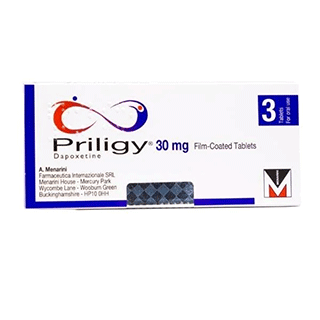
Overview
What is Priligy and what is it used for?
Priligy is a medicine used to treat premature ejaculation in adult men aged 18 to 64. It helps prolong sexual performance by delaying ejaculation, allowing better control during sexual intercourse.
Priligy contains the active ingredient dapoxetine and is suitable for men experiencing premature ejaculation who have not responded to other approaches such as talk therapy.
How Priligy works
Priligy contains dapoxetine, which belongs to a class of medicines called selective serotonin reuptake inhibitors (SSRIs). It works by increasing serotonin levels in the nervous system, which helps delay ejaculation, though the exact mechanism is not fully understood.
When you may notice results
Priligy is a short-acting medicine. The maximum effects occur 1–2 hours after taking the tablet. It should be taken before anticipated sexual activity, not on a continuous daily basis.
How to take Priligy
- Take one tablet 1–3 hours before sexual activity.
- Swallow the tablet whole with a full glass of water.
- Can be taken with or without food.
- Do not take more than one tablet in 24 hours.
- Priligy should only be taken when sexual activity is anticipated — it is not for daily use.
Important safety information
- Age restriction: Priligy is only suitable for men aged 18 to 64.
- Alcohol: avoid drinking alcohol while taking Priligy, as it can increase dizziness, drowsiness, and slow reactions.
- Fainting risk: Priligy can temporarily lower blood pressure and may cause fainting. Avoid situations where injury could occur if you faint.
- Tell a clinician if you have a history of depression, psychiatric disorders, or mood changes.
- Do not take if you have heart problems, liver or kidney disease, or are taking certain other medicines (especially antidepressants or MAO inhibitors).
Side effects of Priligy
Like all medicines, Priligy can cause side effects, although not everyone gets them. Some side effects can be mild, while others require medical attention.
Common side effects may include
- Dizziness or light-headedness
- Headache
- Nausea
- Drowsiness or tiredness
- Difficulty sleeping (insomnia)
- Diarrhoea
If side effects persist or become troublesome, speak to a clinician.
Get urgent medical help if
- You experience symptoms of a psychiatric disorder such as erratic mood swings, impulsive behaviour, or severe depression
- You feel faint or lose consciousness
- You develop signs of an allergic reaction (swelling of face/lips/tongue, difficulty breathing, severe rash)
- You have suicidal thoughts or feel at immediate risk
Frequently asked questions
How long does Priligy last?
Priligy is a short-acting medicine. Its effects peak 1–2 hours after taking it and it is eliminated from the body relatively quickly, which is why it should only be taken before sexual activity, not daily.
Can I take Priligy every day?
No. Priligy should not be taken on a continuous daily basis. It should only be taken 1–3 hours before anticipated sexual activity, with a maximum of one tablet in any 24-hour period.
Can I drink alcohol while taking Priligy?
It is not recommended. Taking Priligy after drinking alcohol can increase feelings of dizziness, drowsiness, and slow reactions. Priligy can also cause fainting by temporarily lowering blood pressure.
Is Priligy suitable for everyone?
Not always. Priligy is only suitable for men aged 18–64 with premature ejaculation. A clinician will check your suitability, including medical history, current medicines, and any history of mood disorders, heart, liver, or kidney problems.
Can Priligy be used with erectile dysfunction treatments?
In some cases, yes. A clinician can advise whether it is safe to use Priligy alongside treatments for erectile dysfunction based on your individual circumstances.
Always read the patient information leaflet before use.
Side Effects
As with all medicines, dapoxetine may cause side effects in some people. Full details can be found in the manufacturer’s patient information leaflet.
The majority of side effects are usually mild and manageable; however, in rare cases, more serious reactions can occur.
Stop taking dapoxetine and seek medical advice immediately if you experience any of the following:
Seizures or fits
Fainting or dizziness, particularly when standing up
Noticeable changes in mood or behaviour
Thoughts of self-harm or suicide
Cautions
Some men with certain medical conditions may not be suitable for treatment with dapoxetine unless they have first discussed it with a healthcare professional. This includes men with any of the following:
A history of low blood pressure or symptoms related to sudden drops in blood pressure, such as dizziness or fainting when standing
Heart-related conditions
Moderate to severe liver or kidney impairment
A predisposition to angle-closure glaucoma (a rare type of glaucoma)
Bleeding disorders or problems with blood clotting
Epilepsy
Severe lactose intolerance
OnlineUKPharmacy’s online consultation is designed to identify these contraindications and ensure dapoxetine is prescribed safely and appropriately.
Dapoxetine can also interact with certain prescription medicines. As part of the OnlineUKPharmacy consultation, patients are screened for medications that may interact with Priligy. Some interacting medicines must be stopped at least 14 days before starting dapoxetine and should not be restarted until 7 days after the last dose.
Do not discontinue any prescribed medication without first seeking advice from a doctor or pharmacist.
All patients prescribed Priligy should carefully read the manufacturer’s patient information leaflet before beginning treatment.